Innovation
The Gap Between a Great Care Pathway and a Great Outcome? It's Almost Never the Protocol.
3 min read
To receive communications about products, events and other exciting announcements
3 min read
When a fixation procedure goes well, the fracture heals and the patient recovers. When surgical site infection (SSI) occurs, the outcome can be profoundly different and far harder to treat.
For ankle fractures treated with open reduction and internal fixation (ORIF), that risk is real and persistent. Reported SSI rates range from 1.5% to 17%, shaped by patient, injury and surgery-related factors. In patients with poorly controlled diabetes, rates can be up to 50%. In open fractures, deep infection affects up to 17%. These are not rare cases. They represent a meaningful proportion of the patients most surgeons encounter.
What makes SSI particularly difficult is what happens afterwards. Once infection is established, management becomes complex, prolonged and uncertain. Evidence from the periprosthetic ankle infection literature shows that even established strategies such as DAIR (Debridement, Antibiotics, and Implant Retention) can fail, and DAIR outcomes specific to fracture ORIF remain unstudied. All revision strategies carry their own morbidity and functional outcomes can suffer. The case for prevention is self-evident but the question of how implant design fits into that prevention strategy is not often discussed.
Why the Distal Tibia Is Different
Not all anatomical sites carry equal risk. The distal tibia, and pilon fractures in particular, present a specific challenge. The soft-tissue envelope here is thin, subcutaneous cushioning is limited, and local vascularity is poor-conditions that are made considerably worse by high-energy trauma. Add to this the systemic risk factors commonly seen in this patient group-advanced age, smoking, obesity and peripheral vascular disease-and the margin for error narrows considerably.
Implant prominence becomes more than a technical detail when hardware sits proud of the bone, places direct mechanical pressure on the overlying skin, raises tension at wound closure and further compromises vascularity that is already fragile. This is a plausible and underappreciated pathway to wound breakdown and deep infection. If the soft-tissue envelope is the weak link, and in the distal tibia it frequently is, then reducing mechanical load on that envelope is a legitimate clinical objective.
Low-Profile Design as a Preventive Principle
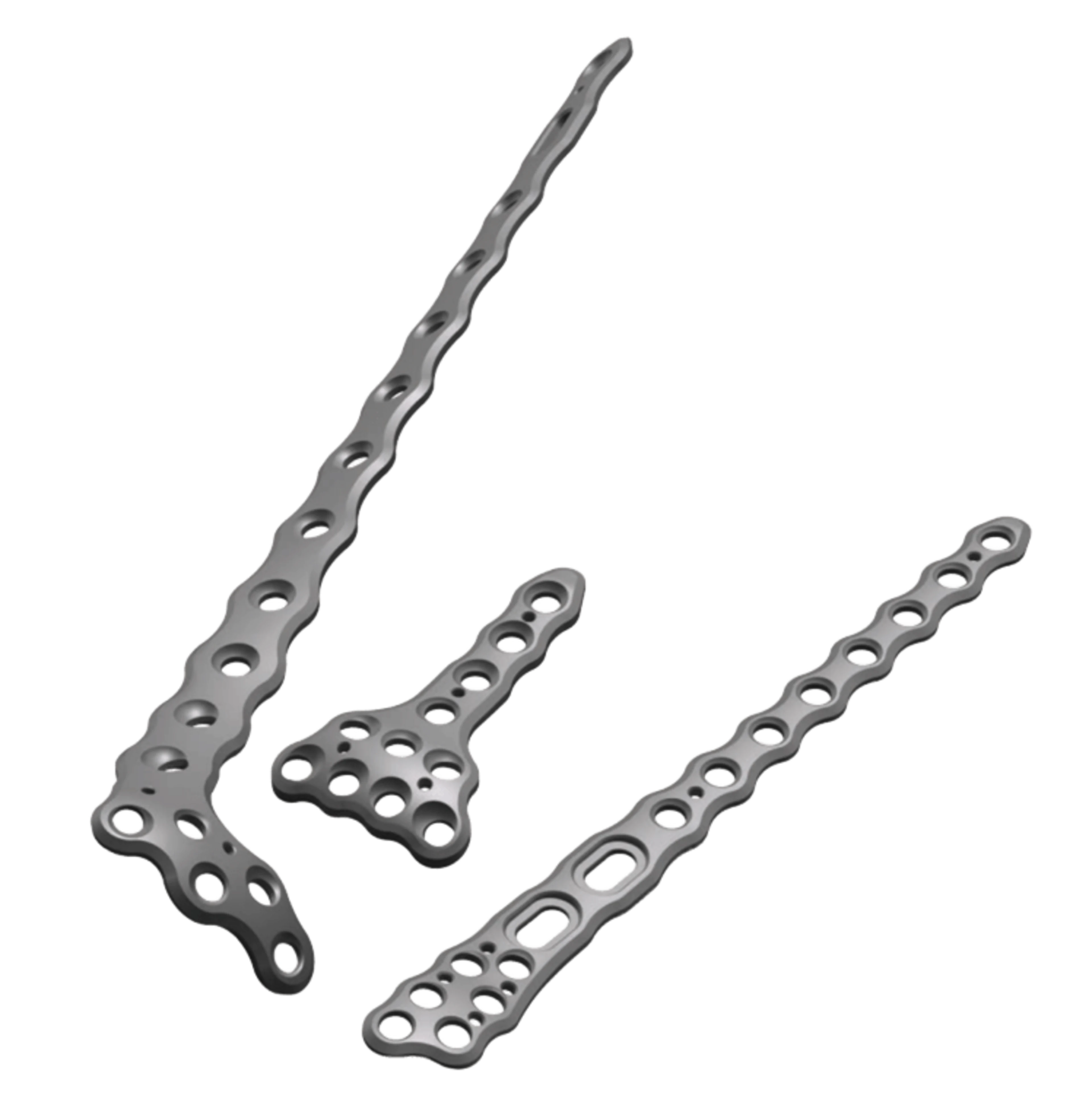
The logic behind low-profile plating is straightforward: a plate that sits closer to the bone imposes less pressure on the skin above it. In a region where swelling, haematoma and surgical stripping already raise skin tension, even modest reductions in prominence may influence whether a wound heals cleanly or breaks down. The Zimmer Biomet A.L.P.S. mvX™ Ankle Fracture System reflects this design thinking in practice. Its anatomically contoured plates are engineered to minimise prominence and soft-tissue irritation, with plate thickness ranging from 1.3 to 2.3 mm depending on the type of plate. This allows the surgeon to match the implant profile to the specific anatomical demands of each fracture rather than accepting a uniform thickness in all situations. Further design features are intended to support this preventive rationale. The system uses type 2 anodised titanium for increased fatigue strength over stainless steel. Variable angle locking screws provide a 30° cone of angulation, enabling fixation directed towards optimal bone stock while keeping screw head prominence low-a detail that matters most precisely where skin cover is thinnest. Together, these elements are designed to provide a stable fixation with genuine respect for the soft-tissue envelope.
A Balanced View of the Evidence
The biomechanical and anatomical rationale for low-profile fixation is sound, but direct prospective evidence linking reduced implant profile to lower SSI rates in the distal tibia remains limited. However, implant selection is part of a broader preventive framework-alongside timely surgery, appropriate antibiotic prophylaxis, perioperative glucose optimisation and meticulous soft-tissue handling. Well-designed comparative studies-ideally multicentre and prospective-could clarify whether plate profile influences wound complications once other variables are controlled.
Looking Ahead
The conversation around SSI is shifting-from managing infection after it occurs to preventing it from arising in the first place. Implant design is an active part of that shift. Low-profile systems such as A.L.P.S. mvX offer surgeons the flexibility to tailor fixation to the fragile anatomy of the distal tibia. The next step belongs to the evidence and to future studies.
Innovation

Innovation